.png)


.png)
Last month, a packed room in Tokyo brought together Minerva students, startup founders, investors, and business leaders for Minerva x Venture Café Tokyo’s Lightning Pitch Night.
Held in partnership with Venture Café Tokyo, the event welcomed more than 40 Minerva students for an evening of rapid-fire startup pitches, live feedback and conversations with leaders across Japan’s innovation ecosystem. Judges included the Head of Learning at Woven by Toyota, the Head of Marketing & Operations at Uber Eats Japan, a social entrepreneurship professor and angel investor from HKUST, and the CEO of NewLocal, one of Japan’s leading social enterprises.
For many students, the night marked the first time presenting their ideas publicly outside the classroom.
Creating a Space to Build in Public
For Moldir Zhumakhan, one of the student ambassadors who helped organize the event, the goal was to create an accessible space where students could experience what it feels like to pitch an idea in front of a broader entrepreneurial community.
“As a Venture Café Tokyo ambassador, I was inspired by how welcoming and open the space felt, even for the earliest-stage ideas,” she said. “We wanted every participant to walk away having experienced what it feels like to put their idea out into the world.”
Zhumakhan said the event aimed to lower the barrier many early-stage founders face when sharing ideas publicly for the first time.
“Having an idea is one thing, but finding the courage to share it is another,” she said. “What makes Minerva special is that although it feels school-scaled, it connects students to a truly global environment. By pitching at Venture Café, students were taking their very first step toward getting their startup seen internationally, with a supportive and low-stakes setting to learn how their ideas are received.”
Across the evening, she noticed a common thread amongst the strongest teams. “The pitches that stood out most were the ones that were concrete, evidence-based, and deeply aware of their competition,” she said. “Across many pitches, I noticed a pattern of students who had done the real work, and it showed in how persuasively they could defend their ideas.”
From Classroom Project to Startup Pitch
Among the student founders presenting was M26 student Katerina Folkin, who pitched Momentum, a learning and development platform she has spent the past year building as her senior capstone project.
Presenting the project publicly for the first time carried emotional weight. “Presenting it externally for the first time was a genuinely special moment,” she said. “It felt like all the work I'd poured into it had finally taken shape in the real world.”
Folkin said one of the most valuable parts of the evening was hearing directly from both judges and fellow student founders.
“The feedback from the judges was invaluable, offering perspectives I hadn't considered before,” she said. “Hearing fellow students share their startup ideas was incredibly intellectually stimulating. It’s been a while since I've been in an environment that is uplifting and full of energy.”
Reimagining Financial Habits for Gen Z
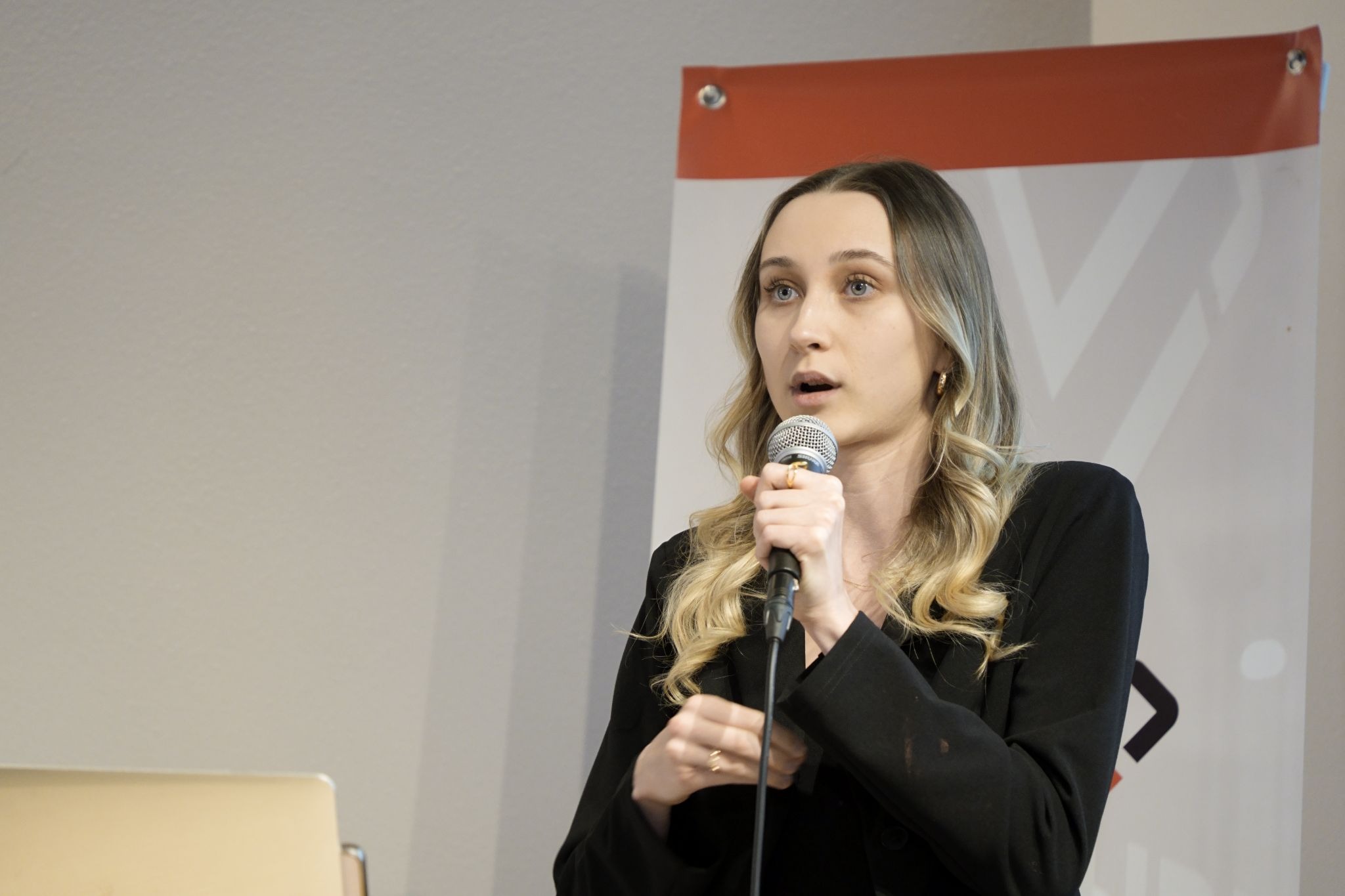
Another student team presented Welo, a gamified social finance app designed to help students track spending and split costs without traditional budgeting tools feeling restrictive or tedious.
“Welo is the Duolingo of personal finance,” said M27 student Cristian Dinuta. “It’s a social, gamified expense app that helps students track spending and split costs without it feeling like homework.”
The team believes existing finance apps struggle not because users dislike budgeting, but because most platforms fail to create lasting engagement. “Existing apps on the market make you feel watched, not motivated,” Dinuta said. “Welo flips this.”
“With Apple Pay, subscriptions running in the background, and in-app purchases, money is leaving the account in a way we barely notice,” said Dinuta. “At the same time, Gen Z controls over a trillion dollars in spending power, yet gets very little financial education.”
Welo uses streaks, badges, and a social feed where friends share their money wins and deals.
The project began as a Minerva Civic Project in San Francisco before expanding into a larger team spanning multiple cities and disciplines — Cristian, Katia, and Mulyn alongside two Google engineers. "Between us, we cover computer science, cognitive science, data science, and economics," Dinuta said. "A lot of Welo has been shipped over voice notes, 11 p.m. calls, and Google Docs communications."
One of the biggest takeaways from the event came from feedback around the team’s long-term business model. “The strongest version of Welo is not one where we eventually start showing ads,” Dinuta said. “It’s one where the way we make money is the same thing that helps users save it.”
The Welo app is live on the App Store and can be viewed at welofinance.com. Following the event, the team plans to continue pitching the platform in San Francisco while meeting with investors and mentors.

Building Tools for Neurodivergent Users
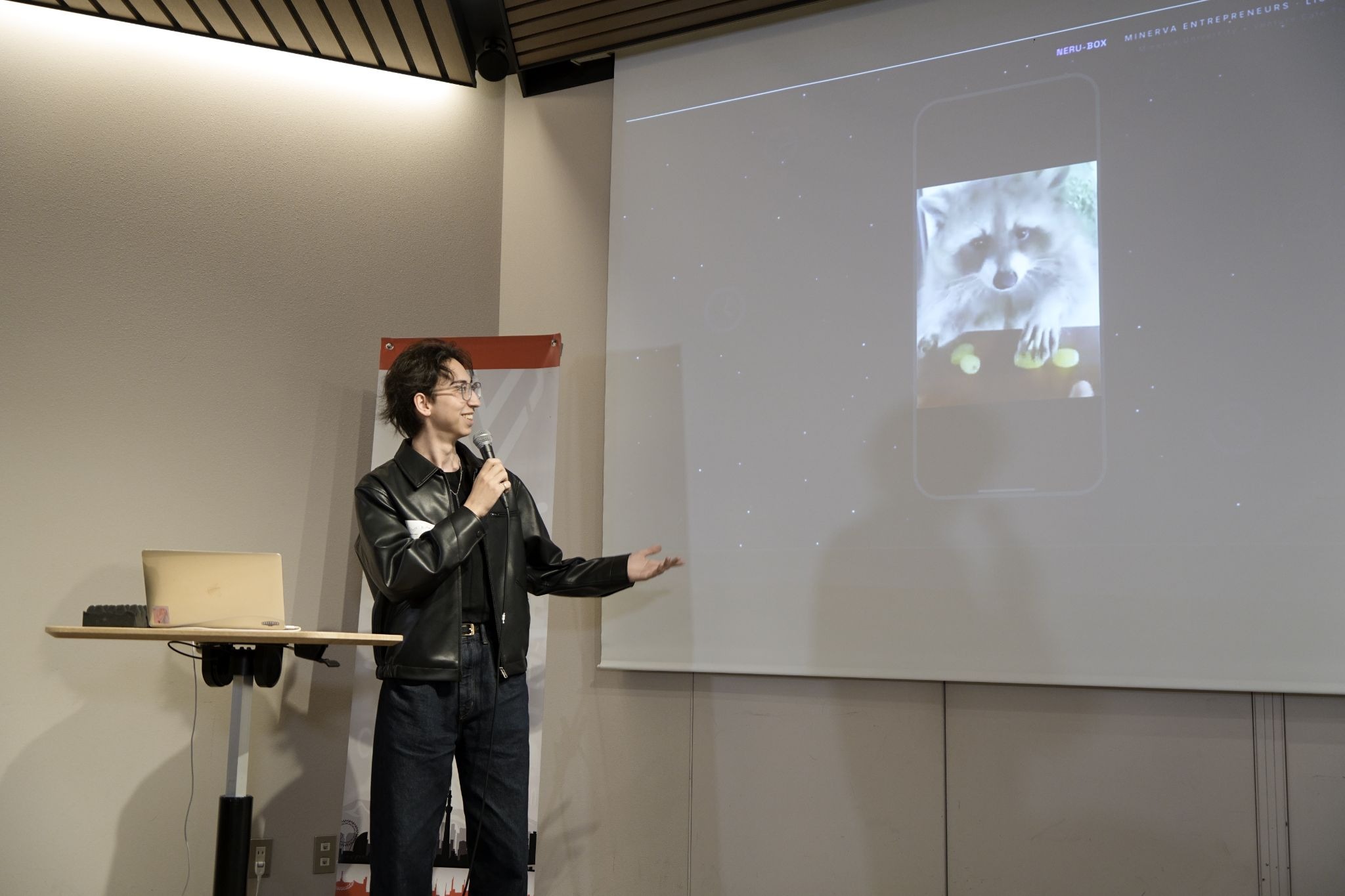
Another project, Neru-box, focused on helping Gen Z users, particularly neurodivergent individuals, build healthier habits and reduce doomscrolling through behavioral science and creative design.
“We want to help Gen Z, mainly neurodivergent people, such as those with ADHD or autism, develop good and healthy habits considering our modern digital era,” said M28 student Rafael Belmonte.
For Belmonte, the project is deeply personal. “My brother is autistic, and he struggles a lot with the problems we are trying to solve,” he said. “This startup is the way for me to use my skills to help him face those challenges independently.”
The team's work spans neuroscience, engineering, and product design. Belmonte and co-founder Otávio, a software engineer and his best friend since high school, first built an early version of Neru-box as their capstone project for an electronics technician degree — long before Minerva. "The most difficult challenge in the past few months was juggling university, work, and life while working on this project in completely opposite time zones," Belmonte said. "He is in Brazil, and I was in Japan."
One piece of feedback from judges helped the team rethink how they define the core of their product. “One of the judges asked us what the most lovable feature of our idea was,” he said. “That question helped us lock in on what should be the focus right now.”
The team is now preparing testing and prototyping phases with Minerva students and other users, including Belmonte’s brother, before releasing a showcase video of their robot companion concept.
Learning Beyond the Classroom
For many participants, the evening reflected a broader aspect of Minerva’s global model: learning by building, testing and engaging directly with communities outside the classroom.
“Building something from scratch is deeply personal,” Zhumakhan said. “Experiences like this teach you how your idea lands with strangers, which is ultimately the most honest signal you can get.”
She hopes the event encouraged students to continue pursuing their ideas long after the night ended.
“Pitching in front of a live audience takes real courage,” she said. “I hope that experience reminded them that their ideas are worth pursuing further.”
Quick Facts
Computational Sciences
Computational Sciences
Natural Sciences
Computational Sciences
Arts & Humanities, Natural Sciences
Social Sciences & Arts and Humanities
Business
Computational Sciences
Computational Sciences
Social Sciences & Business
Computational Sciences
Social Sciences
Computational Sciences & Business
Business & Computational Sciences
Computational Sciences
Computational Sciences
Social Sciences & Business
Business
Natural Sciences
Social Sciences
Social Sciences
Social Sciences & Business
Business & Computational Sciences
Business and Social Sciences
Social Sciences and Business
Computational Sciences & Social Sciences
Computer Science & Arts and Humanities
Business and Computational Sciences
Business and Social Sciences
Natural Sciences
Arts and Humanities
Business, Social Sciences
Business & Arts and Humanities
Computational Sciences
Natural Sciences, Computer Science
Computational Sciences
Arts & Humanities
Computational Sciences, Social Sciences
Computational Sciences
Computational Sciences
Natural Sciences, Social Sciences
Social Sciences, Natural Sciences
Data Science, Statistics
Computational Sciences
Business
Computational Sciences, Data Science
Social Sciences
Natural Sciences
Business, Natural Sciences
Business, Social Sciences
Computational Sciences
Arts & Humanities, Social Sciences
Social Sciences
Computational Sciences, Natural Sciences
Natural Sciences
Computational Sciences, Social Sciences
Business, Social Sciences
Computational Sciences
Natural Sciences, Social Sciences
Social Sciences
Arts & Humanities, Social Sciences
Arts & Humanities, Social Science
Social Sciences, Business
Arts & Humanities
Computational Sciences, Social Science
Natural Sciences, Computer Science
Computational Science, Statistic Natural Sciences
Business & Social Sciences
Sustainability
Sustainability
Natural Sciences & Sustainability
Natural Sciences
Sustainability
Computational Sciences
Computational Sciences
Computational Science & Business
Data Science and Statistics
Data Science and Statistics, Digital Practices
Earth and Environmental Systems
Cognition, Brain, and Behavior & Philosophy, Ethics, and the Law
Computational Theory and Analysis
Computer Science and Artificial Intelligence
Brand Management & Computer Science and Artificial Intelligence
Computer Science and Artificial Intelligence
Economics and Society & Strategic Finance
Enterprise Management
Economics and Society
Cells and Organisms & Brain, Cognition, and Behavior
Cognitive Science and Economics & Political Science
Applied Problem Solving & Computer Science and Artificial Intelligence
Computer Science and Artificial Intelligence & Cognition, Brain, and Behavior
Designing Societies & New Ventures
Strategic Finance & Data Science and Statistics
Brand Management and Designing Societies
Data Science & Economics
Machine Learning
Cells, Organisms, Data Science, Statistics
Arts & Literature and Historical Forces
Artificial Intelligence & Computer Science
Cells and Organisms, Mind and Emotion
Economics, Physics
Managing Operational Complexity and Strategic Finance
Global Development Studies and Brain, Cognition, and Behavior
Scalable Growth, Designing Societies
Business
Drug Discovery Research, Designing and Implementing Policies
Historical Forces, Cognition, Brain, and Behavior
Artificial Intelligence, Psychology
Designing Solutions, Data Science and Statistics
Data Science and Statistic, Theoretical Foundations of Natural Science
Strategic Finance, Politics, Government, and Society
Conversation
Last month, a packed room in Tokyo brought together Minerva students, startup founders, investors, and business leaders for Minerva x Venture Café Tokyo’s Lightning Pitch Night.
Held in partnership with Venture Café Tokyo, the event welcomed more than 40 Minerva students for an evening of rapid-fire startup pitches, live feedback and conversations with leaders across Japan’s innovation ecosystem. Judges included the Head of Learning at Woven by Toyota, the Head of Marketing & Operations at Uber Eats Japan, a social entrepreneurship professor and angel investor from HKUST, and the CEO of NewLocal, one of Japan’s leading social enterprises.
For many students, the night marked the first time presenting their ideas publicly outside the classroom.
Creating a Space to Build in Public
For Moldir Zhumakhan, one of the student ambassadors who helped organize the event, the goal was to create an accessible space where students could experience what it feels like to pitch an idea in front of a broader entrepreneurial community.
“As a Venture Café Tokyo ambassador, I was inspired by how welcoming and open the space felt, even for the earliest-stage ideas,” she said. “We wanted every participant to walk away having experienced what it feels like to put their idea out into the world.”
Zhumakhan said the event aimed to lower the barrier many early-stage founders face when sharing ideas publicly for the first time.
“Having an idea is one thing, but finding the courage to share it is another,” she said. “What makes Minerva special is that although it feels school-scaled, it connects students to a truly global environment. By pitching at Venture Café, students were taking their very first step toward getting their startup seen internationally, with a supportive and low-stakes setting to learn how their ideas are received.”
Across the evening, she noticed a common thread amongst the strongest teams. “The pitches that stood out most were the ones that were concrete, evidence-based, and deeply aware of their competition,” she said. “Across many pitches, I noticed a pattern of students who had done the real work, and it showed in how persuasively they could defend their ideas.”
From Classroom Project to Startup Pitch
Among the student founders presenting was M26 student Katerina Folkin, who pitched Momentum, a learning and development platform she has spent the past year building as her senior capstone project.
Presenting the project publicly for the first time carried emotional weight. “Presenting it externally for the first time was a genuinely special moment,” she said. “It felt like all the work I'd poured into it had finally taken shape in the real world.”
Folkin said one of the most valuable parts of the evening was hearing directly from both judges and fellow student founders.
“The feedback from the judges was invaluable, offering perspectives I hadn't considered before,” she said. “Hearing fellow students share their startup ideas was incredibly intellectually stimulating. It’s been a while since I've been in an environment that is uplifting and full of energy.”
Reimagining Financial Habits for Gen Z
Another student team presented Welo, a gamified social finance app designed to help students track spending and split costs without traditional budgeting tools feeling restrictive or tedious.
“Welo is the Duolingo of personal finance,” said M27 student Cristian Dinuta. “It’s a social, gamified expense app that helps students track spending and split costs without it feeling like homework.”
The team believes existing finance apps struggle not because users dislike budgeting, but because most platforms fail to create lasting engagement. “Existing apps on the market make you feel watched, not motivated,” Dinuta said. “Welo flips this.”
“With Apple Pay, subscriptions running in the background, and in-app purchases, money is leaving the account in a way we barely notice,” said Dinuta. “At the same time, Gen Z controls over a trillion dollars in spending power, yet gets very little financial education.”
Welo uses streaks, badges, and a social feed where friends share their money wins and deals.
The project began as a Minerva Civic Project in San Francisco before expanding into a larger team spanning multiple cities and disciplines — Cristian, Katia, and Mulyn alongside two Google engineers. "Between us, we cover computer science, cognitive science, data science, and economics," Dinuta said. "A lot of Welo has been shipped over voice notes, 11 p.m. calls, and Google Docs communications."
One of the biggest takeaways from the event came from feedback around the team’s long-term business model. “The strongest version of Welo is not one where we eventually start showing ads,” Dinuta said. “It’s one where the way we make money is the same thing that helps users save it.”
The Welo app is live on the App Store and can be viewed at welofinance.com. Following the event, the team plans to continue pitching the platform in San Francisco while meeting with investors and mentors.
Building Tools for Neurodivergent Users
Another project, Neru-box, focused on helping Gen Z users, particularly neurodivergent individuals, build healthier habits and reduce doomscrolling through behavioral science and creative design.
“We want to help Gen Z, mainly neurodivergent people, such as those with ADHD or autism, develop good and healthy habits considering our modern digital era,” said M28 student Rafael Belmonte.
For Belmonte, the project is deeply personal. “My brother is autistic, and he struggles a lot with the problems we are trying to solve,” he said. “This startup is the way for me to use my skills to help him face those challenges independently.”
The team's work spans neuroscience, engineering, and product design. Belmonte and co-founder Otávio, a software engineer and his best friend since high school, first built an early version of Neru-box as their capstone project for an electronics technician degree — long before Minerva. "The most difficult challenge in the past few months was juggling university, work, and life while working on this project in completely opposite time zones," Belmonte said. "He is in Brazil, and I was in Japan."
One piece of feedback from judges helped the team rethink how they define the core of their product. “One of the judges asked us what the most lovable feature of our idea was,” he said. “That question helped us lock in on what should be the focus right now.”
The team is now preparing testing and prototyping phases with Minerva students and other users, including Belmonte’s brother, before releasing a showcase video of their robot companion concept.
Learning Beyond the Classroom
For many participants, the evening reflected a broader aspect of Minerva’s global model: learning by building, testing and engaging directly with communities outside the classroom.
“Building something from scratch is deeply personal,” Zhumakhan said. “Experiences like this teach you how your idea lands with strangers, which is ultimately the most honest signal you can get.”
She hopes the event encouraged students to continue pursuing their ideas long after the night ended.
“Pitching in front of a live audience takes real courage,” she said. “I hope that experience reminded them that their ideas are worth pursuing further.”